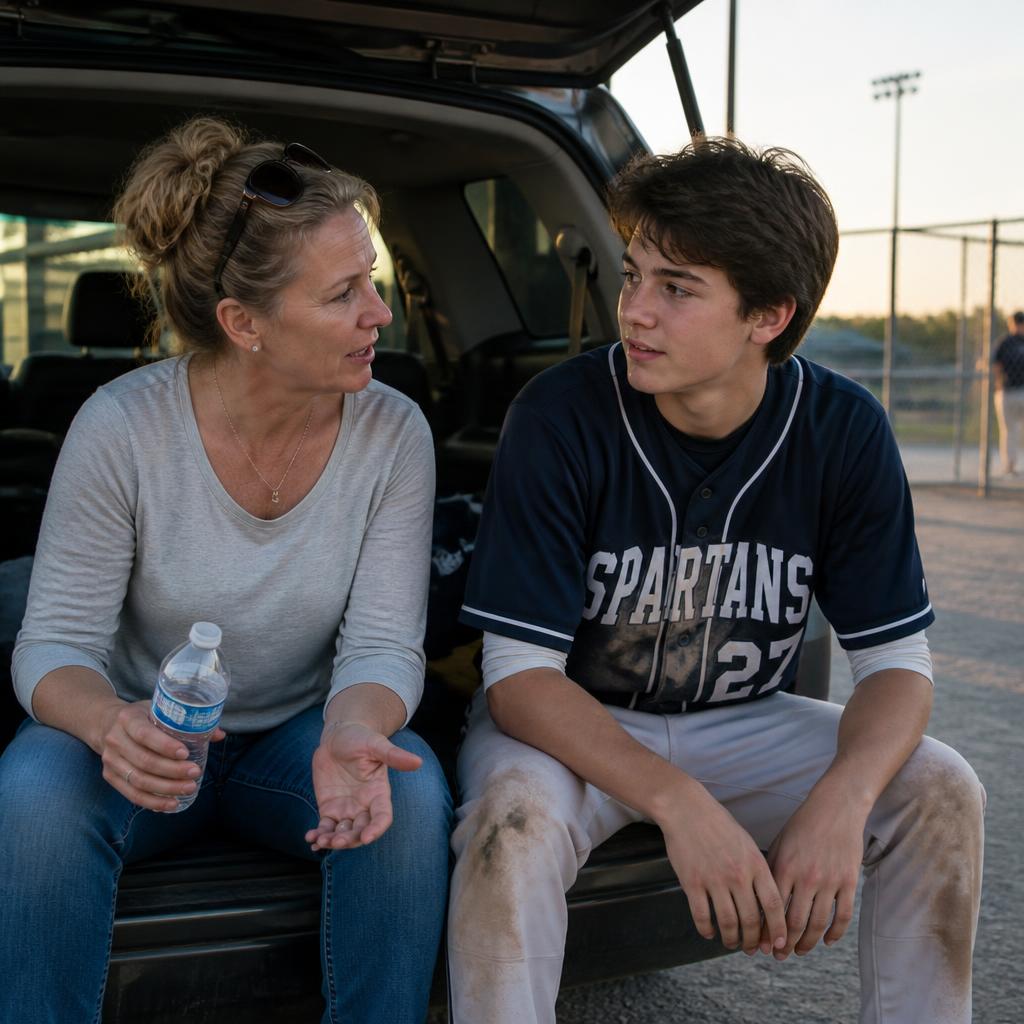
Helping your child bounce back from strikeouts and errors without losing their spark.
The Silence After the Strikeout
The silence of a baseball diamond after a game-ending strikeout is a heavy thing. It’s not just the absence of noise; it’s the sudden vacuum where cheers were supposed to be. For a twelve-year-old standing at home plate, the bat still resting on their shoulder, that silence feels like an indictment. The walk back to the dugout feels like a mile-long trek through deep sand. For the parent watching from the bleachers, it feels like a knot in the stomach.
We’ve all been there. The car ride home that feels three hours longer than it is. Public failure is the crucible of youth sports. It’s the moment where the lessons we talk about—resilience, grit, character—are actually forged. But for many parents, the instinct is to either minimize the pain or maximize the lesson. Both reactions often miss the mark because they focus on the parent's discomfort rather than the child's growth.
Resilient parenting isn't about preventing these moments. It’s about what we do in the immediate aftermath, when the "identity" of the player feels most fragile. It’s about modeling emotional regulation and teaching our children that a mistake is a piece of data, not a character flaw. How we respond determines whether that threat becomes a permanent scar or a stepping stone that builds genuine athletic confidence.
1. The Power of the "Neutral Face"
The most important work a resilient parent does happens in the three seconds after the error occurs. Before a word is spoken, the child’s eyes almost invariably dart to the stands. They are looking for a mirror. They judge the scale of the disaster by the look on their parent's face. If they see a parent wincing or looking away in shame, they internalize that their failure has caused us distress, adding the burden of "disappointing Mom or Dad" to the weight of the loss.
Resilient parents practice the "Neutral Face." This isn't about being cold; it’s about providing a steady emotional anchor. It’s a look that says, I see you, I’m here, and my love for you hasn't shifted one millimeter because of that play. By maintaining a calm, supportive expression, we communicate that their worth is not on the line. This gives the child permission to process their own emotions without having to manage ours simultaneously.
Modeling emotional regulation means showing our children that we are not fragile. If we can handle their failure with composure, they begin to believe they can, too. The "Neutral Face" is the first step in de-escalating the internal crisis that follows a public mistake, signaling that the parent-child bond remains strong.
2. Separating the Player from the Play
In a competitive season, it is easy for a child’s identity to become fused with their performance. Resilient parents are relentless about decoupling these two things. They use language that focuses on the action, not the person. It is the difference between saying "You were sloppy today" and saying "The footwork on that double play was off." One is an indictment of character; the other is a technical observation.
When failure is viewed as an identity judgment, the child becomes "performance-avoidant." They stop taking risks because a mistake feels like a death blow to their self-worth. Resilient parents counter this by consistently treating a strikeout as a "thing that happened" rather than "who you are." They remind the child that they are a person who plays baseball, not a "baseball player" whose entire value is tied to their batting average.
By consistently treating a strikeout as a "thing that happened," we build a psychological buffer. We are teaching them that their value is inherent, not earned on the field. This is the foundation of true athletic confidence: the knowledge that you can fail spectacularly and still be okay. This separation allows the child to approach the next game with freedom.
3. Data Mining vs. Drama Mining
When the conversation eventually turns to the game, resilient parents avoid the "Drama Mine." Drama mining is focusing on the "how could you?" or the "what were you thinking?" It’s an emotional autopsy that leads to defensiveness and shut-down. Drama mining keeps the child stuck in the emotional pain without providing a path forward.
Instead, resilient parents engage in "Data Mining." They treat the mistake as growth information—neutral and useful. A strikeout isn't a tragedy; it’s a report card on specific variables. Was the timing off? Was the pitch selection poor? When we approach failure as a scientist rather than a judge, we take the sting out of it.
Resilience is not the absence of failure, but the presence of a framework that allows failure to be converted into fuel.
This approach shifts the child’s brain from the emotional amygdala to the prefrontal cortex, which handles problem-solving. It empowers them. Instead of feeling like a victim of a bad bounce, they feel like a student of the game who just learned something valuable about how to handle the next curveball.
4. The Five-Minute Processing Window
One of the hardest things for a parent to do is to sit in the discomfort of their child’s sadness. We want to fix it or distract them. But resilient parents know that emotions need to be felt before they can be filed away. Rushing to "positivity" can often feel like a dismissal of the child's very real feelings of disappointment.
They allow for a "Processing Window." This is a period of time where the child is allowed to be upset. We don't try to talk them out of it. We simply acknowledge the reality: "That stings. I know you're disappointed." This validation teaches the child that negative emotions are manageable and part of caring about something.
By validating the emotion without letting it spiral into a catastrophe, we teach them that negative feelings are manageable. Once the emotion has been felt, the child is much more likely to be ready for the "growth information" phase. They have moved through the emotional tunnel and are ready to look at the light of logic.
5. Focusing on the Controllables
In baseball, the outcome is often outside of a player's direct control. A resilient parent helps the child distinguish between the "process" and the "result." They teach the child that you can "win" the process and still "lose" the result, and that the former is the only thing that truly matters in the long run.
They praise the things the child can control: their effort, their attitude, and their reaction to adversity. If a child strikes out but ran hard to first on a dropped third strike, that’s the win. If they made an error but immediately focused on the next play, that’s the victory. This shift in focus protects the child from the inherent unfairness of the game.
The "Controllable Audit": After a tough game, ask your child to name three things they controlled and three things they couldn't. It instantly re-centers their perspective on where their power actually lies.
When we anchor their success to their effort rather than the scoreboard, we give them a sense of agency. They realize that while they can't control the umpire or the wind, they are the absolute masters of their own response. This is the essence of grit—the ability to keep going when the results aren't going your way.
6. Modeling the "Bounce-Back"
Our children are always watching us navigate the small and large failures of our own lives. Resilient parents realize that they are the primary instructors in the school of "how to fail." If we lose our cool when we get a flat tire, we are teaching them that failure is a crisis that demands an emotional outburst.
Resilient parents take the opportunity to narrate their own minor failures. "I really messed up that presentation today," we might say. "I felt embarrassed, but I realized I just need to spend more time on the data next time." By sharing these moments, we normalize failure. We show them that it happens to everyone, even the people they look up to most.
By showing them that we can experience a "public" failure and recover with grace, we provide a blueprint for their own lives. They see that failure isn't a dead end; it’s just a detour. They learn that the "bounce-back" is a skill that can be practiced and mastered, just like a ground ball or a swing.
7. The "Short Memory" Ritual
The best players in the world have what coaches call a "short memory." They have the ability to commit an error in the first inning and hit a home run in the ninth because they have a systematic way to flush the mistake. Resilient parents help their children develop a physical or mental "reset" ritual that signals the end of the past and the beginning of the present.
This ritual could be as simple as wiping the dirt off their cleats or taking one deep "cleansing" breath. It’s a physical anchor that tells the brain the previous play is over. As parents, we can support this by having a "post-game ritual" that signals the end of the evaluation period. Once we step through the front door of the house, the game is over. We are no longer "The Player" and "The Parent-Coach"; we are just a family.
This boundary is crucial for long-term mental health. It prevents the game from bleeding into every aspect of their lives and becoming an all-consuming source of stress. It ensures that the home remains a sanctuary where they are safe from judgment, regardless of what happened on the field.
The Practice of Perspective
Ultimately, the goal of youth baseball isn't to produce professional athletes; it’s to produce resilient adults. The strikeouts and the errors are not obstacles to that goal—they are the very tools we use to achieve it. When we stop viewing public failure as something to be avoided and start viewing it as a necessary part of the journey, the entire atmosphere of the game changes. The pressure lifts, and the "spark" that drew them to the game in the first place begins to shine brighter.
We can’t protect our children from the sting of a public mistake, nor should we try. That sting is what teaches them how to heal and how to grow stronger. Our job is to be the steady hand that guides them through the process, the calm voice that reminds them of their inherent worth, and the model of the resilience we hope to see in them as they grow.
It starts with a simple shift in how we view the next game. Instead of hoping for a perfect performance, we can hope for a moment of adversity that gives our child the chance to practice their bounce-back. And in those moments, we can lean into a short, repeatable confidence practice—a simple way to ground ourselves and our players in the present moment. By focusing on the next pitch and the next play, we teach them that the most important play in baseball is always the next one. It’s not about the error; it’s about the recovery. And the recovery is where the spark truly lives.