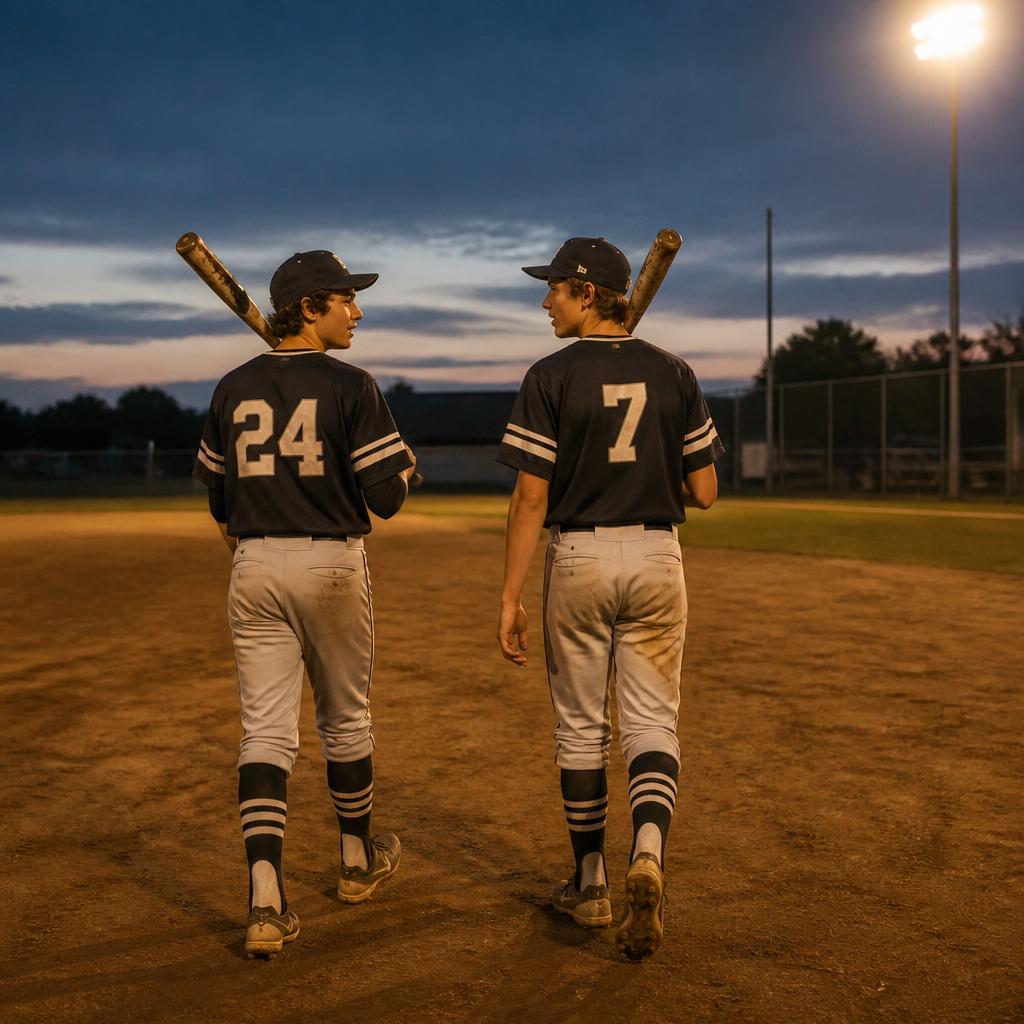
A former pro reflects on the moment he realized silence was the greatest gift he could give his son.
It was a Tuesday night in late April. My son had just gone 0-for-3 with two strikeouts and a weak grounder to second. He was eleven. I was thirty-eight, and I should have known better.
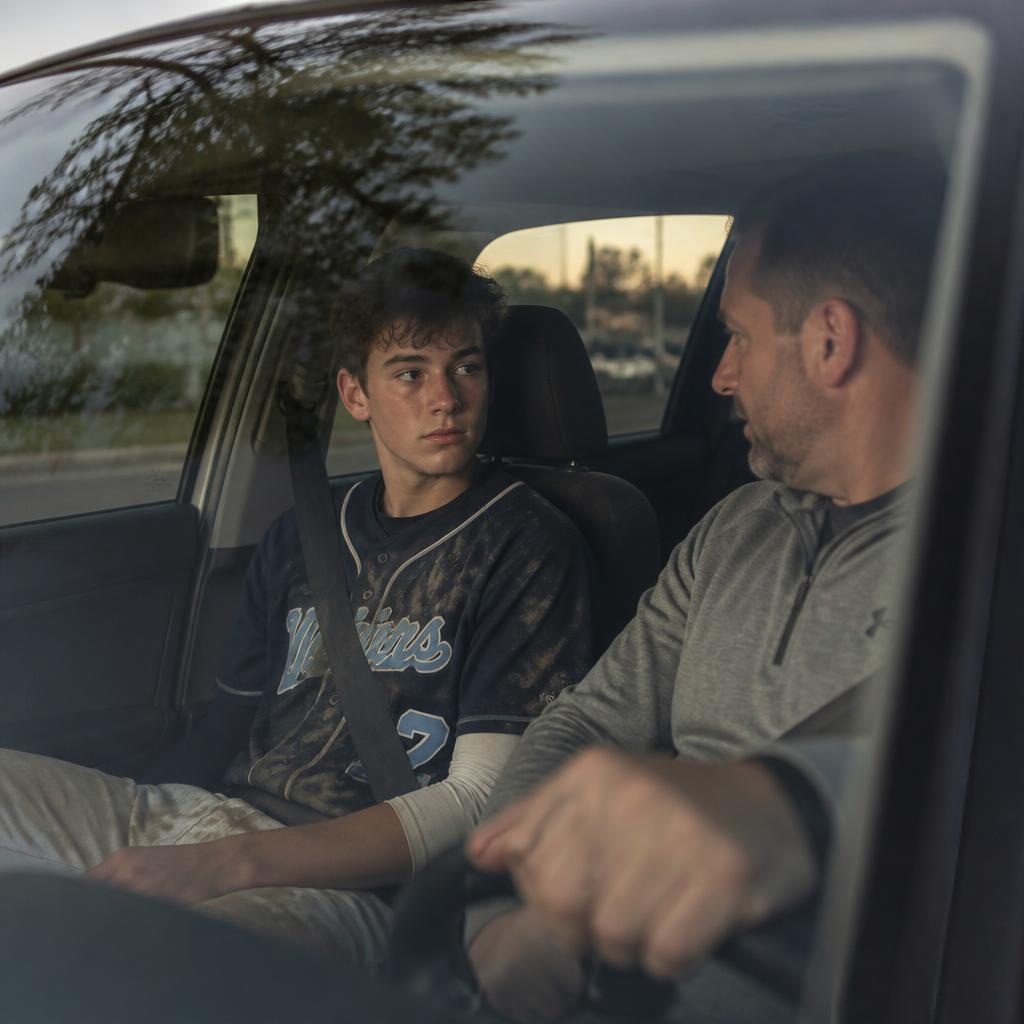
We got in the car. He buckled his seatbelt, stared out the window, and said nothing. I lasted about four minutes.
"You know what the problem was tonight?" I said, keeping my eyes on the road like I was just making casual conversation. "You were dropping your back shoulder on every pitch. You were swinging at balls in the dirt."
He didn't respond. He just kept looking out the window.
"You also need to stop pulling your head. Every single swing. I could see it from the bleachers." I paused. "We've talked about this."
Still nothing.
"Are you even listening to me?"
"Yeah, Dad." Two words. Flat. Exhausted. Done.
I kept going for another ten minutes. By the time we pulled into the driveway, I had covered his stance, his load, his pitch recognition, his effort level, and his attitude. I had diagnosed every flaw I could identify from a metal bleacher sixty feet away.
He went straight to his room. Didn't say goodnight.
What I Didn't Understand Then
I played professionally. I spent years in the minor leagues grinding through slumps, working with hitting coaches, rebuilding my swing from the ground up more times than I can count. I know what it feels like to fail at the plate. I know what it feels like to walk back to the dugout after a strikeout with 200 people watching.
And yet, somehow, I forgot every single one of those feelings the moment I became a baseball dad.
What I didn't understand in that car was this: my son already knew he had a bad game. He didn't need me to tell him. He had been replaying every at-bat in his head since the third inning. He knew about the dropped shoulder. He felt the pulled head. He had been living inside that failure for two hours already.
What he needed from me in that car was not a coaching session.
He needed his dad.
"The car ride home is not a coaching session. It is the most important fifteen minutes you will spend with your child all week. And most of us are wasting it."
I have talked to hundreds of parents over the years — parents of players I coached, parents I met at tournaments, parents who reached out to me after reading something I wrote. And the car ride home comes up constantly. Not because parents are bad people. Not because they don't love their kids. But because they care so much that they cannot help themselves.
They see a problem. They want to fix it. That's what parents do.
But baseball doesn't work that way. And kids don't work that way either.
The Science Behind the Silence
Here is something I learned years after that car ride, when I started studying sports psychology and working with mental performance coaches: after a failure, a young athlete's nervous system is in a state of heightened stress. Cortisol is elevated. The brain is in a defensive posture. The last thing it can do in that state is absorb new information.
When you start coaching your kid in the car after a tough game, you are not teaching them. You are adding stress on top of stress. You are confirming what their brain is already telling them — that they failed, that they disappointed you, that they need to be fixed.
And here is the part that breaks my heart when I think about it: every time that happens, the child's brain begins to associate baseball with that feeling. Not with joy. Not with competition. Not with the smell of fresh-cut grass and the crack of a bat.
With dread.
Research in youth sports psychology consistently shows that the single greatest predictor of long-term athletic enjoyment is whether a child feels safe to fail. Not skill level. Not coaching quality. Not talent. Safety.
And the car ride home is where that safety is either built or destroyed, one conversation at a time.
The Night Everything Changed
About three weeks after that Tuesday night, my son had another rough game. Two strikeouts again. A pop-up in the infield. He was quiet walking to the car. I was quiet too — but this time, it was intentional.
I started the engine. I turned on the radio. I said nothing.
About five minutes into the drive, he spoke first.
"I think I'm swinging too early."
I kept my eyes on the road. "Yeah? What makes you think that?"
"The fastball looked slow. Like I was expecting something off-speed."
"That's a really good observation," I said. And I meant it.
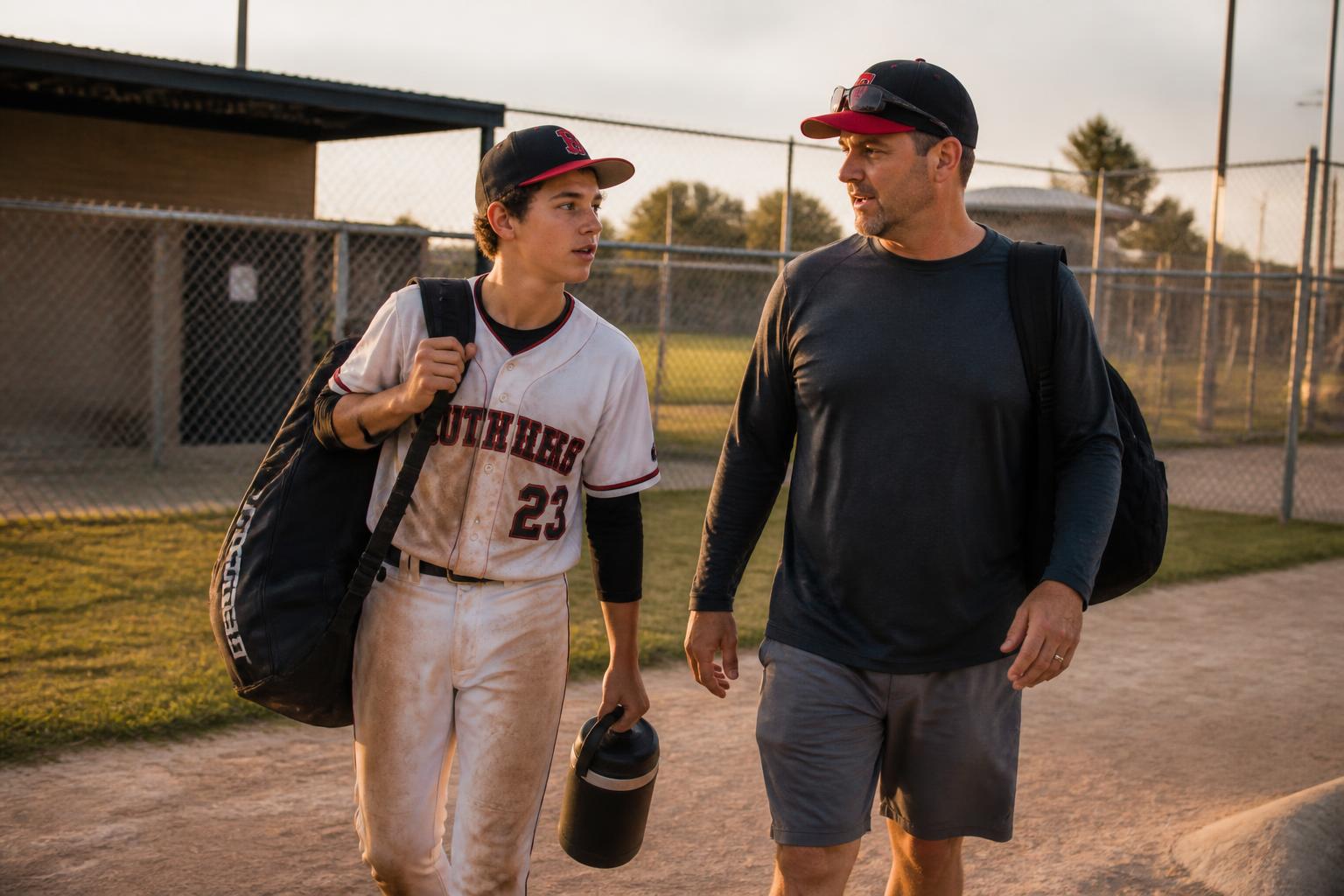
We talked for the rest of the drive. Not me lecturing him. Both of us talking. Him leading. Me asking questions. By the time we got home, he was already thinking about what he wanted to work on at the next practice.
That was the first time I understood what the car ride could actually be.
"When you stop talking, your kid starts thinking. And a kid who thinks for himself is a kid who owns his development."
What I Tell Parents Now
When I work with families, I give them what I call the 24-hour rule. For the first 24 hours after a game — good or bad — you do not analyze performance. You do not critique mechanics. You do not offer unsolicited advice.
What you do instead is this:
- You ask one question: "Did you have fun tonight?"
- You listen to the answer without judgment.
- If they want to talk about the game, you follow their lead.
- If they don't, you talk about dinner, or school, or something completely unrelated to baseball.
- You tell them you love watching them play. Not "you played great." Not "you need to work on X." Just: I love watching you play.
That's it. That's the whole framework.
It sounds simple. It is not. I have watched grown men — former athletes, coaches, people who know better — completely fall apart in the car ride home. Because the instinct to fix is so powerful. Because we love our kids so much that watching them struggle is physically painful.
But here is what I know after working with thousands of baseball families: the parents who learn to hold their tongue in the car are the parents whose kids play the longest. They are the parents whose kids come to them voluntarily with questions. They are the parents whose kids still love baseball at sixteen.
The Apology I Owe
My son is in high school now. He still plays baseball. He is good — not because of anything I said in the car, but in spite of it.
A few years ago, I told him about that Tuesday night drive. I told him I was sorry. I told him I understood now what I was doing to him in those moments — not out of cruelty, but out of love that didn't know how to be quiet.
He shrugged. "It's fine, Dad."
Kids are more forgiving than we deserve.
But I think about all the car rides I can't take back. All the moments I filled with analysis when I should have filled them with presence. All the times he sat in the passenger seat, staring out the window, processing a hard game alone — while I talked at him.
You still have time to do it differently.
"The car ride home is not about the game. It is about the relationship. And the relationship is everything."
Practical Takeaways
- Implement the 24-hour rule: no performance analysis for 24 hours after a game.
- Ask one question: "Did you have fun tonight?" Then listen.
- If your child brings up the game, follow their lead — don't redirect to mechanics.
- Replace "you need to work on X" with "I love watching you play."
- Remember: your child already knows they had a bad game. They don't need you to confirm it.
- The goal of the car ride is not to fix your player. It is to protect your relationship.
One Last Thing
After years of playing professionally and working with thousands of baseball families, I realized something that changed the way I think about youth sports entirely.
Mechanics can be taught. Pitch recognition can be developed. Footwork can be drilled.
But confidence — the belief that you belong in the batter's box, that failure is part of the process, that your worth as a person has nothing to do with your batting average — that has to be built carefully, over time, by the people who love them most.
That's ultimately why I created Bulletproof Hitter through Baseball Notes. After watching so many talented kids lose their love for the game — not because they weren't good enough, but because no one ever taught them how to think — I wanted to give families a simple daily framework for building that confidence before it ever has a chance to disappear.
Bulletproof Hitter is not a hitting program. It is a confidence program. It is designed for the player who has all the physical tools but struggles with the mental side — the kid who plays great in practice but freezes in games, the kid who lets one bad at-bat ruin the next three, the kid who is starting to dread the car ride home as much as you are.
It works because it meets kids where they are. Short daily exercises. Real frameworks. Language that actually makes sense to a twelve-year-old.
Parents who go through it with their kids tell me the same thing: "I finally understand what he's going through." That, to me, is the whole point.